Monday, November 15, 2010

Five steps to a better guest room

“Hospitality is making your guests feel at home, even if you wish they were.”  
~Author Unknown

What message does your guest room send to your friends and family when they come to visit?  Is the room the collector of the cast offs from the rest of your home?  The resting place for all the memorabilia from your kid’s school years?  
If your goal is to make your guest feel out of place and eager to leave, no changes need be made, but if you want your guests to feel cherished and welcome, a few minor adjustments can take your guest space from shabby to sophisticated quickly and easily.
Before, this guest room was uninviting and lacked style.
Guest room redone by Rivalee Design
  • Remove everything from the room that is not related to your guests - ironing boards, the goodwill pile, christmas decor... it all has to go.
  • Repaint the walls.  This is a wonderful first step for making over any room, and will instantly clean and freshen the space.
  • Put new sheets on the bed and cover the old comforter with a new duvet cover.  This doesn’t need to be expensive - a decent set of sheets and a clean white duvet cover from Target can go a long, long way.  You can splurge as much as you want on thread counts and fine fabrics, but the point is to make the room feel fresh, clean, and prepared.
  • Accessorize sparingly.  The room should have enough art and accessories so as not to feel empty, but you want to leave lots of clear space on dressers and side tables for them to easily put their own belongings while they stay.  Be sure they have a table surface next to the bed and adequate lighting should they wish to read in bed.
  • Add in some extras.  Set out fluffy white towels and a small basket with little things they might have forgotten - contact lens cases and solution, travel toothpaste, shampoo and soap, lotion, a razor... think of what a five star hotel might provide.  Even a fluffy robe!
These changes can easily cost as little as a couple hundred dollars and can be done in a weekend.  It's not too late to have your holiday guests feel welcome and appreciated.

Sunday, October 24, 2010

Keeping a happy marriage throughout a remodel

All marriages are happy.  It's the living together afterward that causes all the trouble.  
~Raymond Hull


One of my clients shared this cartoon with me and, after a good giggle, it made me think about how often a kind of “marriage counseling” comes into my work.  As both a ballroom dance instructor and an interior designer I have learned a number of things that can make or break a project for a couple, and I’d like to share some of that insight with you.  If you’ve never undertaken a remodel together before, you’re in for a pretty big adventure, and you want to go in with the right attitude and, ideally, the support of a designer that *both* of you like and trust and who can make sure that the final design is one you  both like.

Comic by Besty Streeter
Here are key ingredients to achieving the goals for your home and, when you’re done, still have a happy relationship:

  1. 1)Identify your dream(s).
  2. First, understand that you both have some idea of what this project will end up looking like, but that you might have very different ideas of that end product.   We have to figure out how you want to feel in your home when it’s done, how do you want to live.  The key here is to LISTEN to each other, and don’t judge!  At this stage every idea is valid.

  3. 2)Destroy preconceived notions.
  4. Both partners are going to have some concept of how much it will (or should) cost and how long it will take.  Again, LISTEN to each other and *never* laugh at your spouse.  If you ridicule your partner they’ll just clam up and be that much less open to  your desires when it’s your turn to be heard.  It’s normal for someone not to know how much a sofa or flooring or any of the other ingredients will cost - how often does the price of a kitchen faucet come up in your spouse’s work?

  5. 3)Draw a map.
  6. This is where the designer starts pulling together ideas and options and will ask for decisions.  It often helps to assign “homework” and divide up the decisions - let the husband choose the counters, the wife choose the flooring... and trust the designer to guide the decisions so they all work together.  Agree to honor the work and decisions of the other person.

  7. 4)Demo and remodel.
  8. You are going to face dust and dirt, perhaps weeks without a kitchen or bath, delays, etc.  Last minute decisions will have to be made, and changes approved when things don’t go as planned.  Stay on the same team.  Budget for a night in a hotel or a nice meal out once in a while as part of the project.  Be a cheerleader for your spouse and know that even thought they might stress about different things (she’s worried about the money, he wants the lighting to be just so) their worries are just as valid as your own.    

  9. 5)Celebrate!
  10. As you achieve goals, break out the champagne.  Not just the big goal (the kitchen is done and we are having a housewarming party) but the small goals, too (the cabinets came in!)

  11. 6)Throughout, remember what’s important; your marriage and your family.
  12. There are NO design emergencies, and the cabinet color and finish is NOT more important than your spouse.  If you see your spouse digging in like a mule, chances are that they feel they aren’t being heard, or felt steamrolled on the last 10 decisions.  If you’ve been getting your own way for a while, it might be time to get them really involved again. Or, if *you* start acting like a stubborn mule on a design decision, take a deep breath, set it aside, talk about it with your designer. Go out and get a little perspective.  Sometimes you just need a walk, sometimes you need to go volunteer at a soup kitchen, but do something that reminds you that beautiful design and new kitchens and baths are a luxury and a gift, not a right or emergency.  

  13. Then go kiss your husband or wife.

You’ll learn a lot about yourself and your partner by taking on a remodel together, and it can be surprisingly easy and even fun if you have a though-out budget with a little extra set aside, and keep some light-hearted perspective throughout.  So have fun, and get ready to enjoy your new home!

Friday, July 16, 2010

Staging your home for sale

“You should detail your house like you’d detail your car if it were for sale.  The cost of staging your home is usually less than your first price reduction!” Barb Schwarz

It's hard to stage your own home, and even harder to find the time when you are busy working, raising the kids, and trying to get ready for your next home.  But when you don't stage the house, you're often throwing money away!  

A staging professional can help - they can be objective about your stuff, set clear goals and timeliness, and make the job their number one priority while you go on with your life.  But if you want to tackle staging on your own, here are some tips to help:

  1. Before, this unused guest room hadn't been set up properly.
    After, the room showed it's potential as a bright, cheerful space.
    (Makeover by Rivalee Design)
    1.Landscaping - This is the first impression of your home.  Some buyers won’t even go inside the house if the grass is dead and the trees and bushes are overgrown and abandoned. There is no need to re-landscape your yard, but do bring in fresh mulch, trim back the trees and bushes blocking views of (or from) your home, and try to plant some long lasting blooming plants near the front door and walkway.  If you have a lawn, mow it once or even twice a week.  You only get one chance to make that first impression! 
  2. 2.Painting - Fresh paint can make an old house fresh, clean and inviting for very little money.  In general you want to choose light, neutral colors - you don’t want any buyer making a list of rooms they’d have to paint before they’d move in. Keep color consistent throughout the home (this doesn’t mean all room must be the same, but there should be an easy flow through the house). 
  3. 3.Cleaning - The house MUST be clean and smell fresh. All your personal belongings (laundry, dishes, shoes, mail, toys...) must be put away.  (And don’t just stash it in a closet - buyers look in there too!)  Vacuum the carpets, open windows for fresh air.  Clean the bathroom, especially the toilet and shower, so it sparkles!  The kitchen, too, must be sparkling clean and all pots and pans should be put away.  Make the bed, clear off your night stands.
  4. 4.Lighting - Turn on the lights and open all drapes so the house looks as bright and airy as possible.  If you can arrange it, make all showings during daylight hours.  
  5. 5.Fixing - Get the to-do list DONE, but don’t waste time, because every day your house is on the market costs you MONEY!  So hire a handyman to fix minor items around the house - railings should be secure, sinks should never drip, door handles should turn easily and doors should open and shut without jamming.  These tiny fixes suggest to a buyer whether or not the home has been cared for, and can make or break a sale!
    Your goal is to freshen and update the space enough to show off its assets and get it on the market ASAP.  Spend your time and money wisely and you'll be taking a much bigger check to the bank!  

Wednesday, June 16, 2010

Your house should welcome you home. Start with the front door.

“To feel at home, stay at home.” Clifton Fadiman

A sense of peace and calm should greet you when you walk through your front door, but too often coming home means being hit in the face with a long list of ‘must-dos’, chaotic clutter, unpaid bills, etc... When you have just finished a long day of work, the last thing you need is a long night of... well, work.  

Try to create some spaces in your home that feel warm and welcome.  For some, that means an organized entry way and warm, inviting living room.  Others want an efficient, open kitchen where everything has it’s place.  And some need a spa-like bathroom and restful bedroom for the ultimate retreat.  

Think you need to move to have these dreams come true?  No!  Every one of those things could be created right in your own home!  You might need a hand seeing how your green plaid couch can be used to create a serene, contemporary living room (that’s where we can help) but it IS within your reach.  

Here are five things you can do NOW to make your home more inviting for yourself and your guests.  Walking up to your front door should make you feel welcome, not unwanted.

  1. 1.Sweep it: Leaves and shoes cluttering up your front steps?  Take a broom and sweep it away.  Such a simple thing, but it really changes that first impression.
  2. 2.Clean it: How does your front door look?  Is the window dirty?  Is the door surrounded by cobwebs?  Is the doormat covered in dirt?  Clean it up!  
  3. 3.Sniff it: While outside, take in a good whiff of fresh air, then go inside and sniff.  What do you smell?  Vanilla, cookies, fresh air?  Great!  Trash, diapers, or cat pee (yikes) - not so great.  Take out the trash and clean that cat box IMMEDIATELY.
  4. 4.Gift it:  Go, right now, and find three things that you don’t use and don’t need.  Give or throw them away.  Right now.  No really.  Right now.
  5. 5.Banish the kids: Keep the kid’s toys in their room.  They can bring the toys they are playing with into any room, but then they are stored in their room.  That’s why they have a room.  Kid’s refuse to put away their toys?  My parents put things we left out in “jail”.  First offense, the toy went to “jail” for a day.  Second offense, a week.  Third time that same toy was left lying around?  Well, my parents figured we must not care enough about it, so it was donated to another family.  Boy did we learn to put our toys away!  Remember, it’s YOUR home too! 

Sunday, May 2, 2010

Can a beautiful home make you happy?


“Think of all the beauty still left 
around you and be happy.” 
Anne Frank  

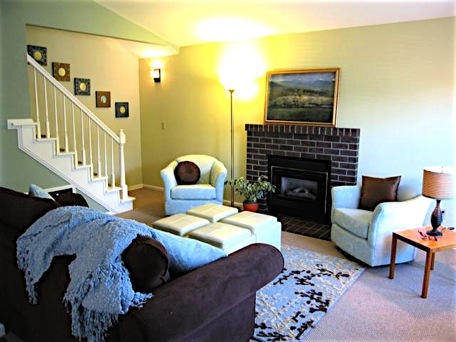
Living room makeover by Rivalee Design

When you walk into a bedroom with clothes on the floor, closet doors bulging, and covers half off the bed, does it set your teeth on edge?  If so, you are not alone.  When I walk into my office and things are in disarray I feel my shoulders tense and my ability to focus goes down the toilet.  Everyone has their own idea of what disorder means (for some, the kitchen counters should be empty but stacks of papers are fine, for others, the bathroom needs to sparkle but making the bed matters not at all) but at some level we all respond to order and beauty, and should give it the priority it deserves.
In the book “Women and Stress” Jean Lush writes that “beauty and a sense of order in your home are functional.  They have a purpose and are not unnecessary luxuries.  Creating beauty around us gives us a sense of accomplishment, charges us with energy, and reduces tension.”

Many of my clients wait years to call me because they feel that spending money on their home is wasteful, self-indulgent and worldly, but as a result they spend those years feeling like their home is unfinished and for many it means that they don’t have friends and family over to enjoy their home because they feel embarrassed.  
“Beauty is not just for the rich and famous.  It is right for everyone and fundamental to emotional health” writes Lush.  And beauty need not be expensive.  It’s about prioritizing the items in your home, getting rid of what is not needed, and making the most of what you have.  Of course, it usually involves a can of paint and a good vacuuming, too, because while things don’t need to be sterile, they should be clean enough that wrestling on the floor with your kids doesn’t give you a face full of old cheerios and dog hair.

Frank Lloyd wright taught his students that beauty dissolves conflicts, quiets us within, inspires us, creates a sense of happiness and serenity, refreshes us, and consoles us in times of depression.  “Beauty,” he added, “is not unnecessary or impractical.”
If life has you feeling overwhelmed, try spending an afternoon getting one room in order.  Take at least 10%, if not 50%, of the Stuff to Goodwill.  Open the windows and close the closet doors.  There is a good chance that you’ll feel better afterwards, and be better prepared to face some of the harder tasks in your life.

Thursday, April 8, 2010

Choosing an area rug - Size Matters

“I don’t understand sizes anymore.  
There’s a size zero, which I didn’t even know they had.  
It must stand for: “Ohhh my God, you’re thin.”
Ellen DeGeneres


A perfectly sized rug can transform a room and enhance its décor; a too-small rug, however, can have the opposite effect.
The number one mistake people make when choosing an area rug is buying a too-small rug!  Even a naked floor is better than a too-small rug, because while a naked floor makes a room look unfinished, a skimpy rug looks cheap, sparse, and choppy.  Read on to learn how to choose the size for your rug, whether you should pay up for a wool rug, and why you should buy a pad for under your new rug.

SIZE 
A rug should anchor the room in which it lives.  Never ‘free float’ an area rug - the idea is to tie the room together.  In the living room it should come within at least a few inches of the feet of all the chairs and sofas, and ideally extend well under and even a few inches behind each chair and sofa.  In the dining room choose a rug that is big enough that when a chair is pulled out to be sat in, its feet stay on the rug.  A good rule of thumb is to add three to four feet to the length and width of your dining table to figure the size of your rug.  It should be small enough, however, that other furniture in the room (such as a buffet) stays off the rug.  In a bedroom the rules are more flexible, but a rug either next to or under the bed should provide a comfortable three foot path all around the bed.
Overall, it’s better to go too big than too small, within the confines that you need to keep air vents and radiators free and that you should still have a nice border around the edges of the rug - at least 6 inches, up to several feet in a really generous room.  Imagine yourself looking down on the room from above and pretend the rug is a picture - it should have a floor ‘frame’ around the outside in proportion to the picture itself.

WOOL vs MANMADE
Once you choose your size, you need to determine the quality of the rug you want.  There are many beautiful synthetic rugs on the market nowadays, and they are often much less expensive than a wool rug.  A synthetic rug can be a good value if you want something a little more ‘disposable’ - perhaps you want to decorate a teen’s room in zebra stripes and you know it’s just a phase.  Know, however, that the rug will lose it’s luster over time (say, 3-7 years depending on the use), and unlike a wool rug, can’t really be revived.  A wool rug, if cared for with professional cleaning occasionally, can last a lifetime, and even become an heirloom.  In other words, unless you are choosing something really trendy, overtime your money will be better invested in the wool rug.   They clean beautifully, look and feel great, and stand up wonderfully to heavy foot traffic.

RUG PADS
Finally, you want to protect your new rug with a rug pad.  It will extend the life of both synthetic and wool rugs by reducing the wear and tear.  It will cushion the step for more comfortable and quieter walking.  It will make a rug on a hard surface safer (not to mention easier to vacuum) by making it slip-resistant.  If you are placing a rug over carpet, a carpet-to-carpet mat can keep spills from soaking through to your carpeting, and also prevent the area rug dye from transferring to the carpet.  It’s more important to have a pad under a rug on a hard floor, but in many instances the carpet-to-carpet pad is also a good use of money.

Tuesday, March 16, 2010

Recovering from divorce through design

Credit: scottsnyde
© scottsnyde - SXC

“If you're going through hell, keep going.” Winston Churchill 

So, you’re newly single.  When you look around your home, do you see your future, or only ghosts and broken dreams?  As painful as divorce is, it is also the beginning of the rest of your life, and if you can embrace this idea you will find a whole new world of possibility waiting for you.
I've been there.  I have faced the pain and embarrassment of knowing that I failed at marriage, and the terror of knowing that every plan I’d made is void and I need a new plan.  I have also faced living in a home that reminded me of that lost life everywhere I looked.
So what did I do?  I repainted every wall, craigslisted some of the furniture, and created a home that said ME instead of US.  And once I was done, I felt like I could start my life again because everywhere I looked I saw a beginning instead of an end.
So, when you are ready to leave the pain and past behind, why not start with a fresh coat of paint?  There is nothing so therapeutic as physical activity, and I can almost guarantee that this will help you restart your life emotionally, mentally, and even physically.
If you have kids you will have to be sensitive to their needs, too, of course.  You can ask them if they want to redesign their room.  Some kids will really need the stability of everything staying the same, and you will need to take things slowly, and just do one room, perhaps your bedroom and master bath, at first.  Other kids will leap at the idea and enjoy this new project with you.  Either way, it’s smart to create a box of mementos of their other parent, even early love letters and photos, for your kids to have for later as they ask questions about your marriage and what happened.  Some of my most treasured items from my own childhood are the cards signed ‘mom and dad’ from the years before my parents’ divorce when I was seven.  
Still, your children learn from everything you do, and if they see you embracing a new future (instead of bashing the past) they can learn optimism and courage, and from you will understand how to make the best of even the hardest situations.